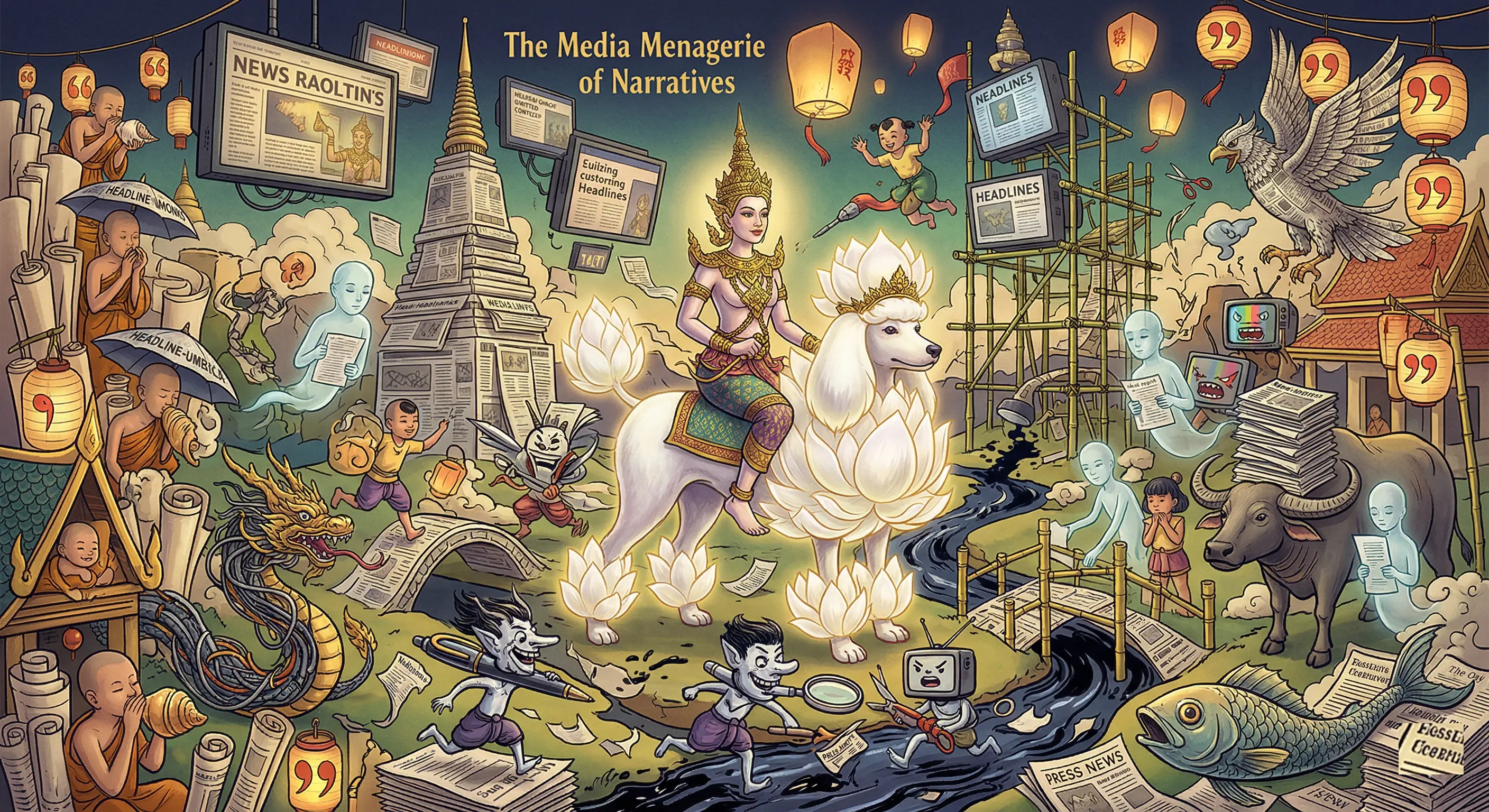
0001 - Media Mechanics: Ownership, Interests, and Editorial Patterns
Structural forces that shape how Thai media construct narratives
1. Event Overview
This post outlines the structural mechanics that influence how Thai media select, frame, and sequence information.
These mechanics operate across outlets regardless of political orientation and are shaped by:
ownership structures
financial dependencies
access incentives
risk‑averse editorial cultures
market pressures
Understanding these mechanics is essential for interpreting narrative shifts in Thai political communication.
2. Ownership Structure
Thai media ownership is concentrated among:
large conglomerates
politically connected families
business groups with diversified interests
stakeholders dependent on government access
Ownership influences:
editorial priorities
acceptable topics
tone and framing
investigative depth
risk tolerance
This creates an environment where stability and continuity are prioritized over confrontation.
3. Financial Dependencies
Most outlets rely on:
advertising revenue
government contracts
business partnerships
sponsored content
reduced newsroom budgets
These dependencies create incentives to:
avoid antagonizing powerful actors
maintain access to official sources
reduce investigative reporting
rely on wire services and press releases
Financial pressure leads to predictable editorial patterns.
4. Editorial Patterns
Across outlets, several recurring patterns appear:
a) Source Weighting
Priority is given to:
official statements
business leaders
institutional voices
Affected groups, independent experts, or dissenting perspectives receive less coverage.
b) Omission
Structural context is frequently omitted, including:
ownership influence
financial dependencies
contradictory official statements
long‑term policy inconsistencies
Omission stabilizes the narrative.
c) Headline Softening
Headlines often:
downplay conflict
avoid strong causal claims
emphasize stability
frame uncertainty as temporary
This reduces perceived volatility.
d) Chronological Compression
Complex sequences are presented as:
linear
coherent
orderly
This masks contradictions and internal disputes.
e) De‑emphasis
Elements that challenge the preferred narrative are:
minimized
placed low in the article
framed as exceptions
This shapes reader perception without explicit censorship.
5. Narrative Construction
Narratives typically follow a three‑phase pattern:
Optimism – positive framing of announcements
Confusion – contradictions emerge
Reframing – responsibility shifted away from institutions
This pattern appears in:
visa policy communication
economic announcements
tourism campaigns
regulatory changes
crisis management
It is a structural feature, not an isolated phenomenon.
6. Public Sentiment
Public reaction often diverges from media framing:
skepticism toward official statements
frustration with unclear communication
reliance on social media for clarification
comparisons with neighboring countries
perception of “managed narratives”
This gap between media framing and public sentiment is a recurring dynamic.
7. Interpretation
Thai media operate within a system shaped by:
ownership concentration
financial dependency
access incentives
risk‑averse editorial culture
The result is a form of stabilizing journalism:
conflict is softened
contradictions are minimized
narratives are adjusted post‑hoc
institutional actors are protected
Understanding these mechanics allows for more accurate interpretation of political communication.
8. Notes
This post describes structural patterns, not individual journalists or political positions.