Home |
Analysis |
How official communication, editorial framing, and public sentiment diverged 1. Event Overview
A sequence of visa‑related announcements triggered a rapid shift in how Thai media framed the topic.
2. Official Communication
Government messaging followed a predictable cycle:
Initial announcement – broad, optimistic, lacking detailClarification phase – ministries issue conflicting interpretationsCorrection phase – earlier statements are walked backStabilization phase – final rules emerge only after public pressure
This pattern mirrors previous cycles in immigration and tourism communication.
Thai outlets applied several recurring frames:
a) Responsibility Framing Responsibility shifted toward:
“foreigners misunderstanding the rules”
“online rumors”
“travel agents causing confusion”
b) Economic Framing Focus on:
tourism recovery
revenue expectations
balancing security with economic needs
c) Stability Framing Presenting the situation as “under control,” even when details were unclear.
d) Human‑Interest Framing Selective individual stories used to illustrate “misunderstandings.”
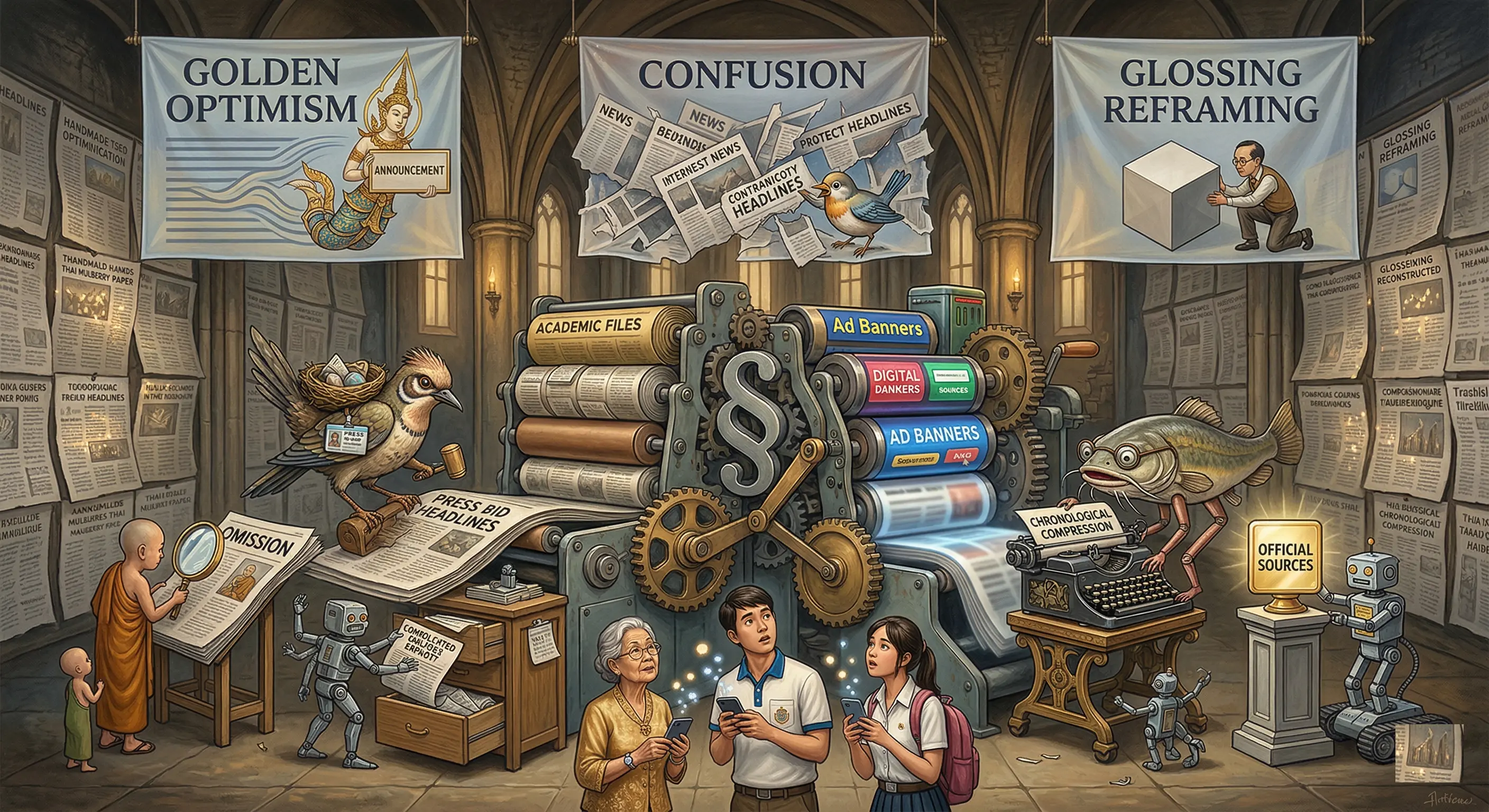
4. Narrative Shift
The storyline evolved in three phases:
Phase 1 — Optimism
“Thailand opens up — new visa rules will boost tourism.”
Phase 2 — Confusion
“Mixed signals cause uncertainty among travelers.”
Phase 3 — Reframing
“Foreigners misunderstood — government clarifies rules.”
This shift redirects attention away from structural communication issues.
5. Editorial Mechanics
Observed across outlets:
Selective omission of contradictory statementsHeadline softening to reduce perceived instabilitySource weighting favoring official voicesChronological compression to create coherenceDe‑emphasis of inconsistencies
These mechanics stabilize the narrative.
6. Public Sentiment
Online reactions diverged sharply:
frustration about unclear rules
skepticism toward official statements
concerns about long‑term immigration stability
comparisons with neighboring countries
7. Interpretation
The visa episode illustrates a structural pattern:
communication is reactive
narratives are adjusted post‑hoc
media act as stabilizers
public sentiment fills the gaps
The result is a predictable cycle of confusion → correction → reframing .
8. Notes
This analysis focuses on narrative mechanics, not policy evaluation.