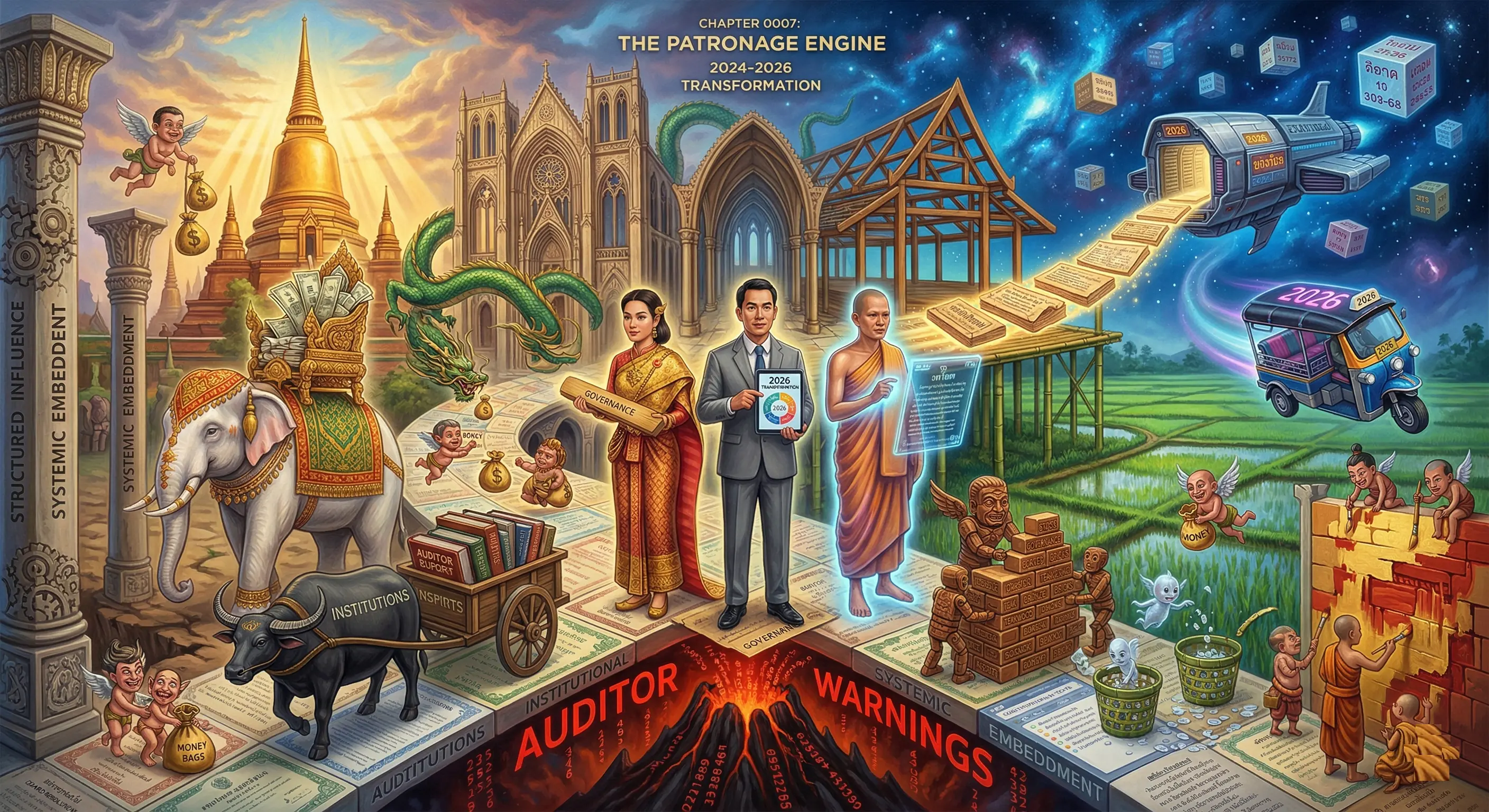
The Bangkok Post is not only undergoing a financial restructuring in 2026 — it is experiencing a deeper institutional and governance realignment.
The documents from 2024–2026 show that the transformation is not merely accounting‑driven, but rooted in:
This entry outlines the financial, institutional, and structural dimensions that explain the shift.
The Bangkok Post will appear financially restored in 2026, but not through operational recovery.
The turnaround is achieved through a large‑scale balance‑sheet operation:
The core mechanism:
👉 Suthikiati Chirathivat exchanges his non‑performing loans for controlling ownership.
This makes the Bangkok Post a subsidised newspaper:
It continues to exist not because it is economically viable, but because a financially powerful patron chooses to sustain it.
This is not a market outcome.
It is patronage‑based financial stabilisation.
The Central family is one of Thailand’s most powerful business dynasties.
Their financial strength and institutional embeddedness explain why the Bangkok Post survives despite:
For the Central Group, the Bangkok Post is not a profit‑seeking asset.
It is a strategic asset with:
Thus:
👉 The survival of the Bangkok Post is structurally tied to the Central family’s capital power.
Wissanu is central to understanding the governance dimension of the transformation.
He is:
His role is institutional, not financial:
His appointment in 2024 was structurally logical:
Wissanu’s long‑standing role in constitutional engineering — including the 2017 constitution — aligns with his function as Chairman of a financially dependent media organisation.
The documents do not show political interference.
But they do show structural proximity, which emerges naturally from:
The structural facts:
This does not mean:
But it does mean:
👉 The structural proximity is real, explainable, and documented.
In Thailand’s media landscape, such embedding is a recurring pattern.
Between 2024 and early 2026, the Bangkok Post’s comment system functioned normally:
From March 2026 onward, a clear operational shift occurred:
The infrastructure was not removed; it was operationally restricted.
Verifiable fact:
The shift began in March 2026, shortly after the political transition.
Unknown:
The underlying cause — no public documentation exists.
The timing is notable, but the reason remains undetermined.
The 2026 AGM documentation includes a full set of proxy forms, including Proxy Form C, used exclusively by foreign shareholders who hold their shares through a Thai custodian.
This mechanism is typical of public‑company governance, even though the Bangkok Post was delisted in July 2024.
The presence of these forms reveals three structural facts:
Even after delisting, the Bangkok Post must follow the procedural framework of the Public Limited Companies Act, including:
This creates the appearance of a public‑company governance environment, even though ownership is now highly concentrated.
The proxy forms assume:
In practice, however, the ownership structure after the 2025 and 2026 conversions is dominated by:
The proxy architecture remains, but its practical relevance is minimal.
The proxy system illustrates a structural tension:
Formally:
The Bangkok Post still behaves like a widely held public company.
Substantively:
The company is now a privately dominated media asset with a single controlling patron.
This contrast is not a contradiction — it is a typical pattern in Thai corporate governance, where legal form and ownership reality often diverge.
2026 is not only the Bangkok Post’s 80th anniversary.
It is the moment when its institutional identity is fundamentally redefined:
The Bangkok Post is no longer an independent market‑driven newspaper.
It is a strategic medium, sustained by actors whose economic and institutional interests are tightly interwoven.
This development is not speculative.
It is the logical outcome of: