On 2 April 2026, Bangkok Post reported on the People’s Party’s (PP) response to the National Anti‑Corruption Commission’s (NACC) decision to petition the Supreme Court in the case involving 44 former MPs.
The case concerns a legislative proposal submitted in 2021 to amend Section 112 of the Criminal Code.
If accepted, the Supreme Court may order:
This development continues an institutional sequence observable since 2021.
The PP leadership articulated several points regarding the proceedings:
These statements provide insight into how political actors perceive the institutional environment in which they operate.
In Thailand’s constitutional framework, “ethics” functions as an undefined, non‑material category detached from objective legal standards.
Without statutory criteria, it bypasses traditional legal thresholds and allows actions to be framed as violations without measurable norms.
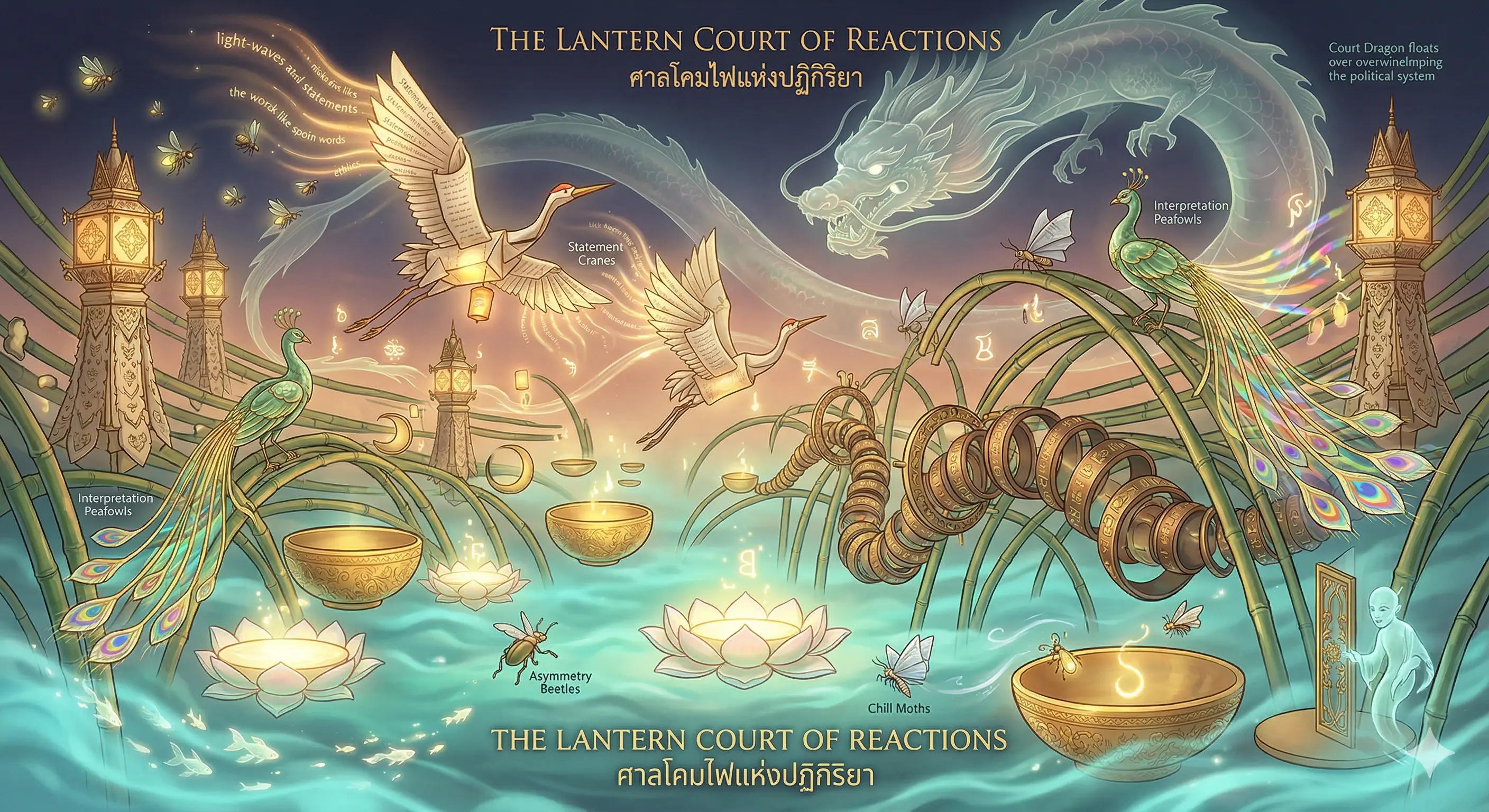
This creates an asymmetry: oversight institutions exercise broad discretion, while elected officials face unpredictable interpretative exposure.
Ethics thus operates as a constitutional wildcard, enabling political sanctions and the halting of debate without criminal findings.
Its vagueness shields the arbiter while placing the subject under maximal legal risk.
The PP’s statements reflect this structural condition: a routine legislative act is treated as an ethical breach, and the category “serious ethical violation” is applied without material standards.
The 2023 and 2026 electoral cycles exhibit a recurring pattern of institutional intervention.
The removal of the 2023 election winner and the dissolution of a major party in 2024 illustrate how ethics‑based reasoning enables disqualifications and party dissolution in the absence of criminal convictions.
This process transforms elections from definitive sovereign acts into provisional outcomes subject to ongoing judicial revision.
Fixed legal thresholds are replaced by subjective moral scrutiny, turning the democratic mandate into a fragile mandate subordinated to institutional oversight and frequent by‑elections.
The April 2026 statements align with this pattern: the same legislative act from 2021 is again used as the basis for proceedings, and the escalation occurs shortly after an election.
The expansion of constitutional ethics review has induced a significant chilling effect on legislative behaviour.
MPs operate under the constant risk that policy debates may be reframed as ethical breaches, triggering suspension or investigation.
This shifts incentives toward risk aversion: legislators narrow their agendas and prioritise procedural caution over substantive engagement.
Because liability is tied to interpretive exposure rather than criminal acts, routine parliamentary activity becomes potentially sanctionable.
The result is a defensive legislature in which actors prioritise institutional safety over policy ambition.
The PP’s concern that MPs may become afraid to perform their legislative duties reflects this dynamic directly.
The statements reported on 2 April 2026 are analytically significant because they:
These statements function as empirical evidence of how constitutional mechanisms shape political practice in Thailand.