Section 235
Subject to section 236, in the case where there is reasonable ground to suspect or there is an accusation that any person holding certain political positions as provided in the Organic Act on Anti-Corruption, judge of the Constitutional Court, person holding a position in an Independent Organ or the Auditor-General is involved in the circumstances under section 234 (1), the National Anti-Corruption Commission shall inquire into facts; if a resolution that such person has been involved in the circumstances or has committed the offence as submitted by the inquiry is passed by votes of not less than one half of the total number of the existing Commissioners that there are grounds in the accusation, the following proceedings shall be taken:
1. in the case of serious contravention or non-compliance with the ethical standards, the matter shall be submitted to the Supreme Court for decision, and the provisions of section 226 paragraph seven shall apply mutatis mutandis to the trial and adjudication of the Supreme Court;
2. in the case other than (1), the inquiry file shall be sent to the Attorney-General for instituting prosecution in the Supreme Court’s riminal Division for Persons Holding Political Positions or to proceed otherwise in accordance with the Organic Act on Anti-Corruption.
In the conduct of an inquiry and passing of a resolution under paragraph one, the National Anti-Corruption Commission shall complete the proceedings within the period of time prescribed by the Organic Act on Anti-Corruption.
When the Supreme Court or the Supreme Court’s Criminal Division for Persons Holding Political Positions has accepted the case, the accused shall cease performing duties until a judgment is rendered, unless the Supreme Court or the Supreme Court’s Criminal Division for Persons Holding Political Positions has ordered otherwise. In the case where the Supreme Court or the Supreme Court’s Criminal Division for Persons Holding the Political Positions has rendered a judgment deciding that the accused is involved in the circumstances or has committed the offence as accused, as the case may be, the convicted person shall vacate office from the date the person ceases performing duties, and the Court shall revoke the right to apply for candidacy in an election of such person and may or may not revoke his or her right to vote for a period of not more than ten years.
Any person whose right to apply for candidacy in an election has been revoked in any case shall permanently have no right to apply for candidacy in an election or selection of Members of the House of Representatives, Senators, members of a local assembly or a local administrator, and shall have no right to hold any political position.
In the case where the Supreme Court’s Criminal Division for Persons Holding Political Positions has rendered a judgment convicting the person of an offence of unusual wealth or corruption, it shall forfeit assets of such person which are acquired from a commission of the offence, including all assets and any other benefits acquired in place of those assets, to be vested in the State.
The consideration of the Supreme Court and the Supreme Court’s Criminal Division for Persons Holding Political Positions shall be based upon the inquiry file of the National Anti-Corruption Commission, and in the interest of justice, the Court shall have the powers to conduct an inquiry to obtain additional facts and evidence.
This section shall apply mutatis mutandis to the persons under section 234 (3) who intentionally fails to submit an account showing assets and liabilities or intentionally submit the same with false statements or conceals facts which should be disclosed, and is involved in circumstances where it could be reasonably believed that the person has intentionally not disclosed the source of the assets or liabilities mutatis mutandis.
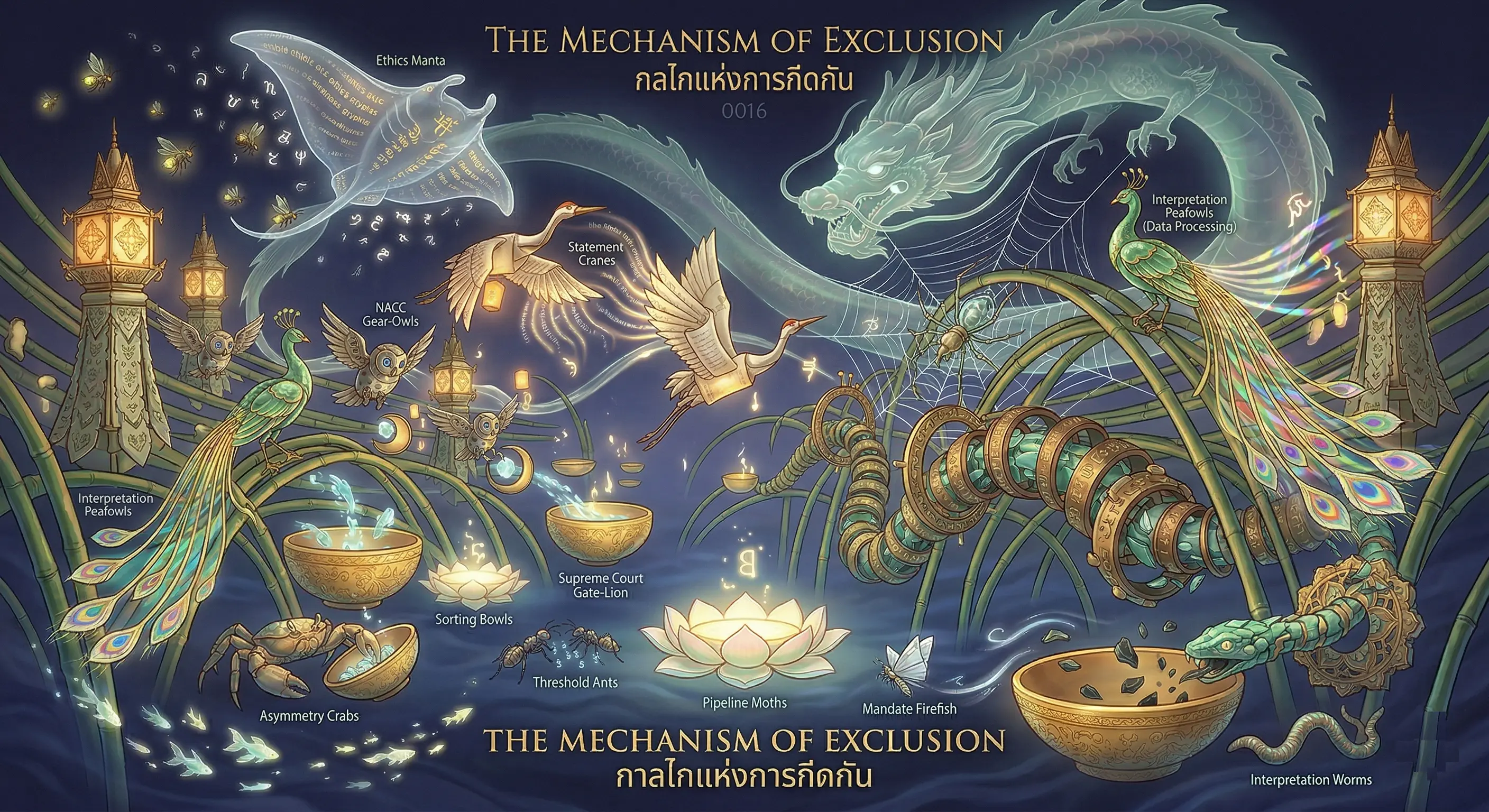
Section 235 of the 2017 Constitution establishes the primary mechanism for removing elected officials through ethical adjudication rather than criminal prosecution.
It authorises the National Anti‑Corruption Commission (NACC) to investigate alleged “serious violations of ethical standards” and to refer such cases directly to the Supreme Court.
This provision forms the constitutional hardware enabling political exclusion through non‑criminal pathways.
Section 235 creates a structured, multi‑stage process:
An allegation of a “serious ethical breach” is filed.
In recent cases, this has included legislative initiatives such as proposals to amend Section 112.
The NACC conducts a fact‑finding investigation.
If not less than half of the commissioners find sufficient grounds, the case proceeds.
Under Section 235(1), cases involving ethical non‑compliance are referred directly to the Supreme Court (Criminal Division for Holders of Political Positions).
This bypasses lower courts and eliminates the evidentiary standards of criminal procedure.
Section 235 authorises sanctions that are political in effect but constitutional in form:
Once the Supreme Court accepts the case, the accused official must cease performing duties, unless the Court orders otherwise.
A finding of guilt results in permanent disqualification from holding political office.
The Court may impose a 10‑year ban on exercising the right to vote.
These sanctions are severe, yet they do not require criminal conviction.
Section 235 establishes a parallel adjudicatory track that operates alongside the criminal justice system but with:
This architecture enables the state to achieve outcomes—such as lifetime exclusion from politics—that would otherwise require criminal charges such as treason or sedition.
The ethical standard applied under Section 235 is undefined, non‑material, and detached from statutory criteria.
This allows ordinary political actions, including legislative proposals, to be reframed as ethical violations without measurable norms.
The result is an asymmetry:
Section 235 operationalises this asymmetry by converting interpretive judgments into enforceable political penalties.
The use of Section 235 in the 2023 and 2026 cycles reflects a recurring intervention pattern:
This transforms elections into provisional outcomes, subject to judicial revision rather than democratic finality.
Section 235 provides the procedural infrastructure for this pattern.
The combination of:
creates a chilling effect on parliamentary activity.
Legislators operate under the risk that policy debates may be reframed as ethical breaches.
This shifts incentives toward risk avoidance, narrowing legislative agendas and prioritising procedural safety over substantive engagement.
Section 235 is the mechanism through which this behavioural shift is enforced.
Section 235 functions as the constitutional hardware of political exclusion in Thailand’s post‑2017 order.
By enabling severe sanctions through non‑criminal pathways, it establishes a parallel judicial mechanism that:
Together, these features make Section 235 a central component of Thailand’s contemporary constitutional mechanics.