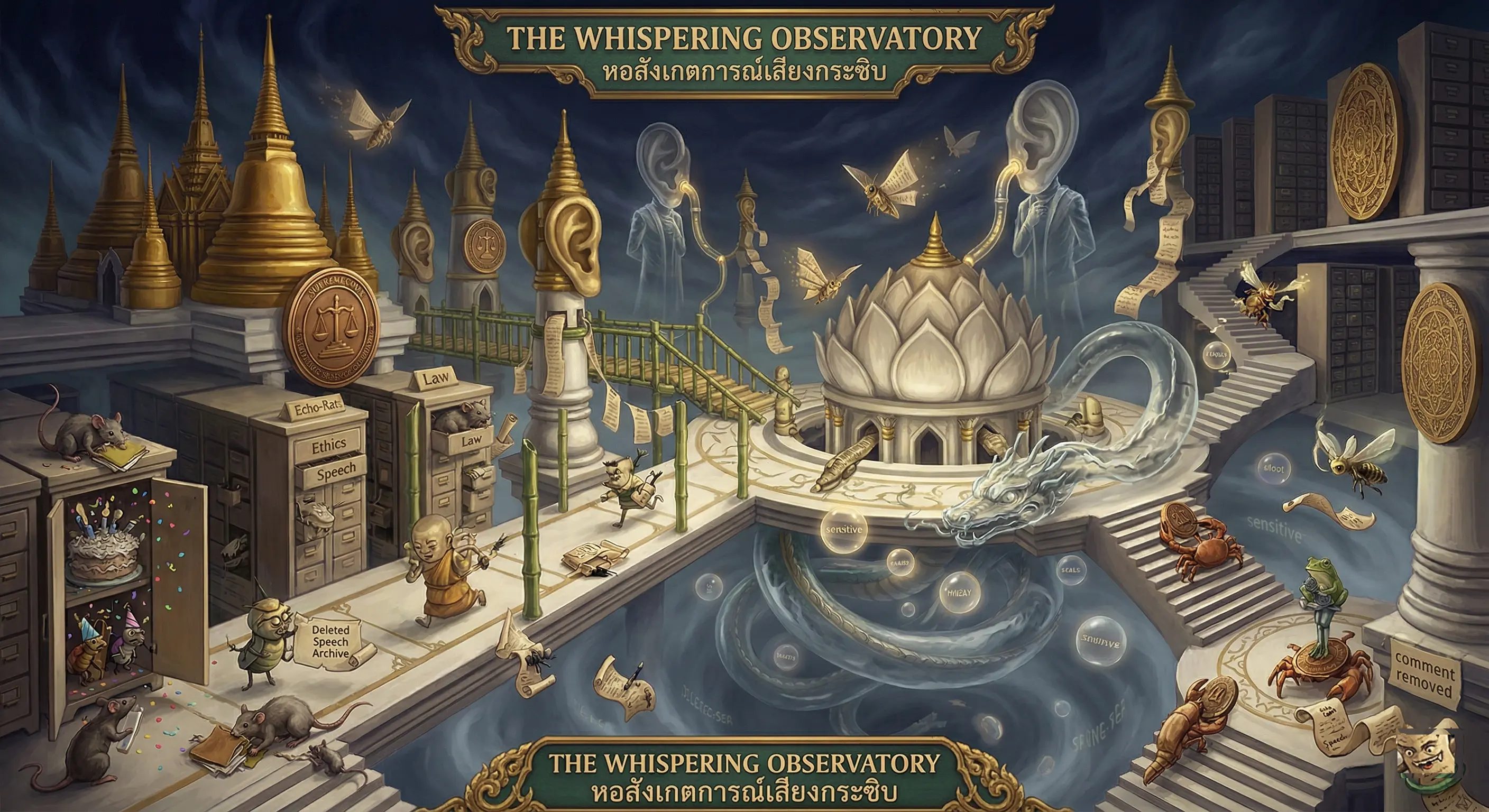
Between 2021 and 2026, public discussion surrounding constitutional interventions, ethics proceedings, and legislative reform proposals was shaped not only by institutional actions but also by discursive filtering.
This chapter examines how comment moderation systems on major Thai news platforms structure what forms of public speech become visible.
The analysis does not focus on individual outlets.
It examines patterns observable across multiple platforms.
Across major Thai news sites, comment moderation guidelines typically prohibit:
These categories are broad and open‑ended, allowing moderators to remove comments that touch on:
The result is a discursive perimeter around sensitive topics.
Empirical observation across multiple articles shows a consistent pattern:
Comments that:
These comments are usually filtered out before publication.
Comments that:
These comments tend to pass moderation.
The filtering pattern produces a specific informational environment:
The public cannot see comments that explain:
Comments that survive moderation typically describe:
But they do not explain why these reactions occur.
Institutional actions are visible.
Structural explanations are not.
This produces a discursive vacuum in which:
The filtering regime mirrors the institutional architecture analysed in Chapters 0012–0018:
Just as Section 49 enables preventive intervention, comment moderation prevents the emergence of structural critique.
Just as “ethics” lacks statutory definition, moderation categories such as “inappropriate” or “sensitive” are open‑ended.
Just as oversight bodies have broad interpretive authority, moderators have broad discretion to remove comments.
Just as legislators narrow their agendas, commenters narrow their speech to avoid removal.
The discursive environment reinforces the institutional environment:
both limit the visibility of structural analysis.
Discursive filtering on major Thai news platforms functions as a parallel mechanism of constraint that complements constitutional intervention.
It does not silence all speech.
It silences specific types of speech:
What remains visible is affective speech — emotion without structure.
This produces a public sphere in which:
Discursive filtering is therefore a non‑institutional extension of the constitutional mechanics documented in Chapters 0012–0018.