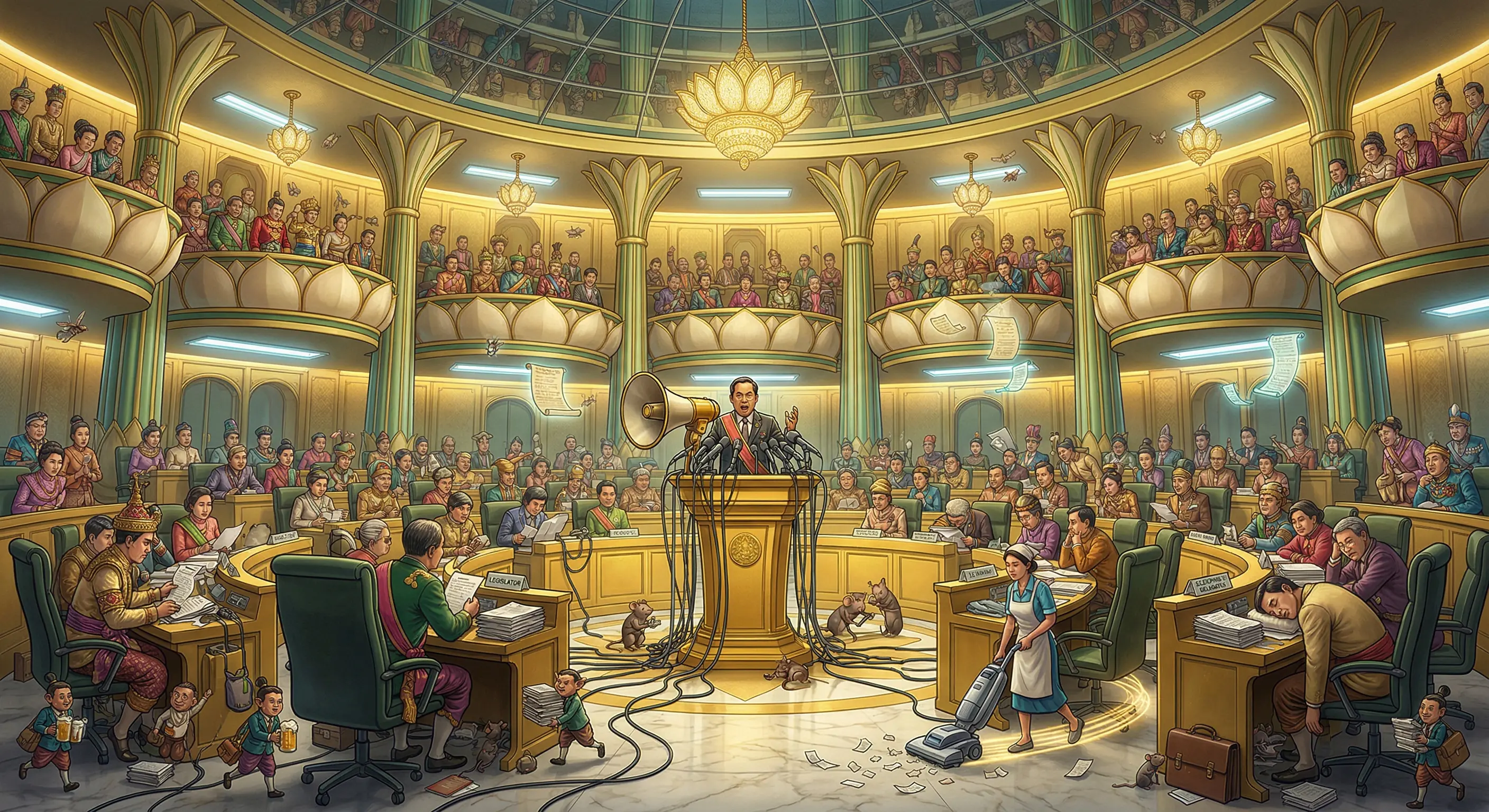
Between 2021 and 2026, constitutional oversight mechanisms increasingly shaped not only electoral outcomes and political eligibility but also the internal functioning of parliament itself.
This chapter examines how preventive jurisprudence, ethics‑based adjudication, and institutional sequencing generate a procedural chilling effect within the legislative chamber.
The analysis focuses on structural consequences, not political positions.
Parliamentary procedure is formally governed by:
However, the introduction of ethics‑based constitutional sanctions alters the incentive structure inside the chamber.
Because acceptance of an ethics case by the Supreme Court triggers automatic suspension, MPs must consider:
The possibility of lifetime bans under Section 235 creates a strong deterrent against:
Because ethical standards are non‑material, MPs cannot rely on statutory definitions to determine what is permissible.
This uncertainty shifts parliamentary behaviour toward self‑limitation.
The chilling effect manifests in several observable procedural shifts.
Committees and caucuses increasingly avoid topics that:
This reduces the scope of parliamentary deliberation.
Before a bill is introduced, MPs conduct informal risk assessments:
This creates a shadow layer of procedural review not found in the standing orders.
MPs may abstain from:
not because of political disagreement, but because of risk management.
Committees handling legal, constitutional, or rights‑related matters adopt:
Parliamentary leadership adapts to the new environment through:
Sensitive topics may be:
Leaders may discourage members from:
Caucus meetings increasingly include:
This transforms parliamentary leadership into a risk‑mitigation authority.
The chilling effect on parliamentary procedure mirrors the constitutional mechanics analysed in earlier chapters:
Parliament anticipates potential intervention and adjusts behaviour before any ruling occurs.
Because ethical violations lack statutory definition, MPs cannot rely on legal certainty.
The possibility of suspension or disqualification shapes internal decision‑making.
Public debate is constrained, reducing external support for parliamentary deliberation.
Together, these mechanisms create a self‑regulating legislature in which procedural caution becomes a dominant organising principle.
The chilling effect on parliamentary procedure represents the internal dimension of Thailand’s contemporary constitutional mechanics.
It is characterised by:
Parliament remains formally autonomous, but its internal operations are shaped by the anticipation of external intervention.
This completes the analytical arc of Chapters 0012–0019:
from legislative initiative → to constitutional interpretation → to institutional sanction → to discursive filtering → to internal procedural transformation.