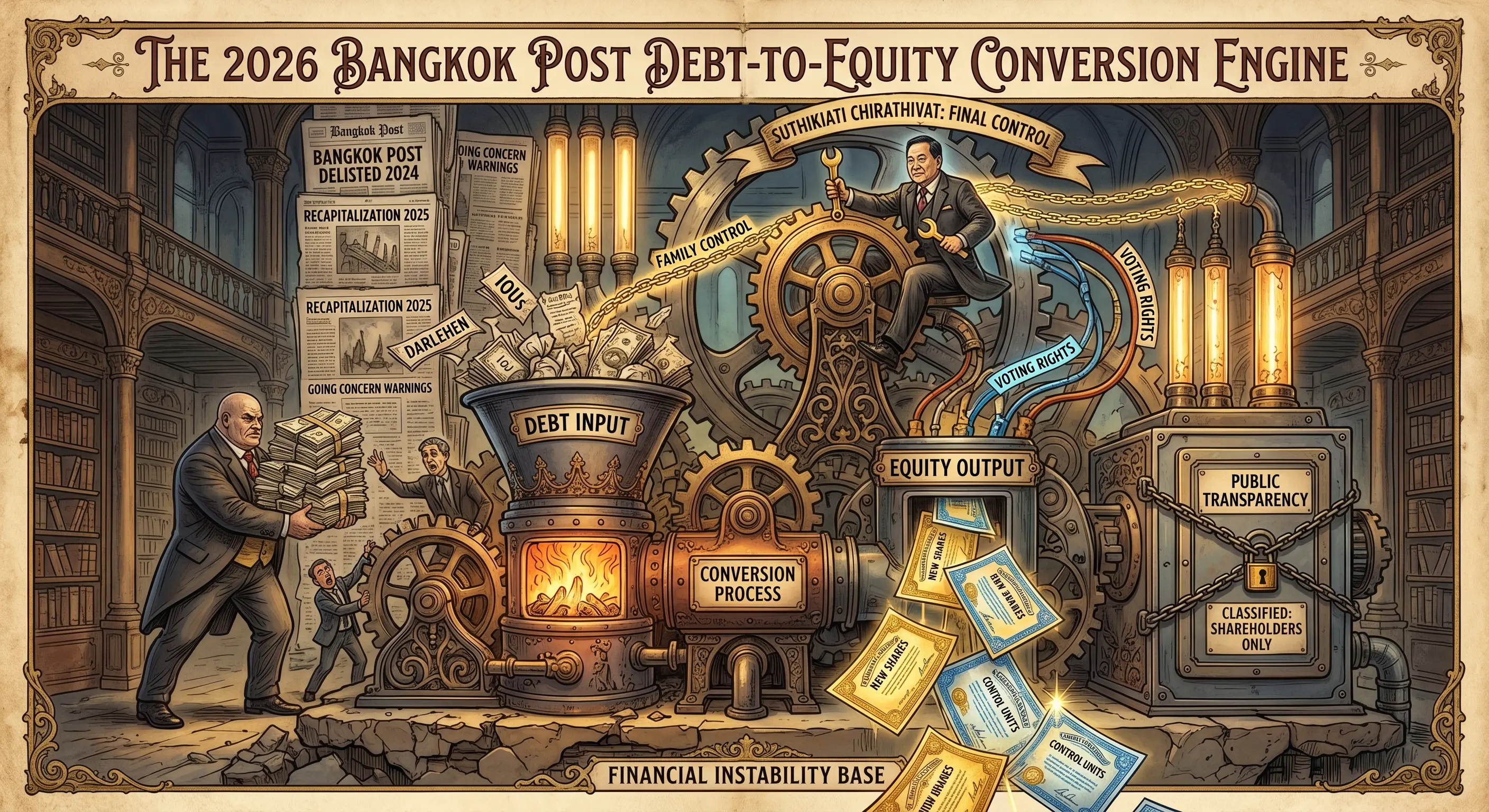
0044 – Bangkok Post: Debt‑to‑Equity Conversion and Ownership Realignment (2024–2026)
How unpayable loans were transformed into ownership and reshaped the company’s structure
1. Overview
Between 2024 and 2026, the Bangkok Post underwent a financial restructuring driven by insolvency, negative equity, and dependence on creditor financing.
The company could not repay its loans, leading to a sequence of debt‑to‑equity conversions that transferred ownership to its creditors.
This document explains:
who provided the financing
how much money was involved
why the company could not repay
how debt was converted into equity
what the creditors ultimately own
how this reshaped the ownership structure
2. Financial Condition (2024–2025)
The Bangkok Post entered 2024 in a state of balance‑sheet insolvency.
Key indicators:
Equity (2024 audited): –444m Baht
Accumulated losses (mid‑2025): 954m Baht
Cash on hand (2024): 3.66m Baht
Total liabilities (mid‑2025): 558m Baht
The company lacked liquidity, profitability, and the ability to service or repay its debts.
3. Creditors and Loan Exposure
Two creditors financed the Bangkok Post during its loss‑making years.
a) Suthikiati Chirathivat (Executive Chairman)
Provided substantial private loans to maintain operations.
298m Baht (converted in 2025)
321.82m Baht (outstanding in 2025)
Total exposure: ~620m Baht
b) Bangkok Bank
Extended institutional credit.
71m Baht (converted in 2025)
71.36m Baht (outstanding in 2025)
Total exposure: ~71m Baht
Total debt owed to both creditors: ~700m Baht
4. Inability to Repay
The Bangkok Post could not repay these loans due to:
negative equity
insufficient cash flow
declining revenue
persistent operating losses
lack of external investment
absence of collateral with sufficient value
Under normal conditions, this would result in default.
Instead, the company initiated a restructuring process.
5. Debt‑to‑Equity Conversion
The central mechanism of the restructuring was the conversion of debt into equity.
a) Definition
A creditor relinquishes the right to repayment and receives newly issued shares.
b) Balance‑sheet effect
liabilities decrease
equity increases
solvency improves on paper
no new cash enters the company
ownership shifts to the creditors
minority shareholders are diluted
c) Application at the Bangkok Post
The company issued new shares to its creditors in exchange for the cancellation of outstanding debt.
6. Ownership Changes (2025–2026)
a) 2025 Conversion
Debt converted:
298m Baht (Suthikiati)
71m Baht (Bangkok Bank)
Resulting ownership:
58% Suthikiati
15% Bangkok Bank
27% minority shareholders
b) 2026 Conversion (AGM Notice, 8 April 2026)
Capital increase:
500m → 1.238bn Baht
738m new shares issued
allocated exclusively to Suthikiati and Bangkok Bank
paid through conversion of existing debt, not new cash
Expected ownership:
>70% Suthikiati
12–15% Bangkok Bank
<15% minority shareholders
The creditors become the controlling owners.
7. Material Assets and Actual Value
The Bangkok Post’s material assets are limited.
a) Main building (Rama IV / Klong Toey)
Estimated market value: 300–500m Baht
b) Printing equipment
Old, depreciated, low resale value: near zero
c) Office equipment, IT, vehicles
Fully depreciated, minimal value
d) Brand “Bangkok Post”
Strategically significant but:
not recorded as an asset
no market valuation
value depends on reputation, not physical assets
Total material value: approximately 350–500m Baht
This is significantly lower than the ~700m Baht in loans converted into equity.
8. Interpretation
The restructuring reflects:
insolvency (negative equity, unpayable debt)
creditor financing (private and institutional)
balance‑sheet repair through debt cancellation
ownership concentration via equity issuance
institutional rather than commercial value of the newspaper
The process did not restore operational profitability.
It redefined the company’s ownership and governance structure.
9. Notes
This document describes the financial and structural mechanisms of the restructuring.
It does not address editorial content, political positions, or individual actors beyond their financial roles.