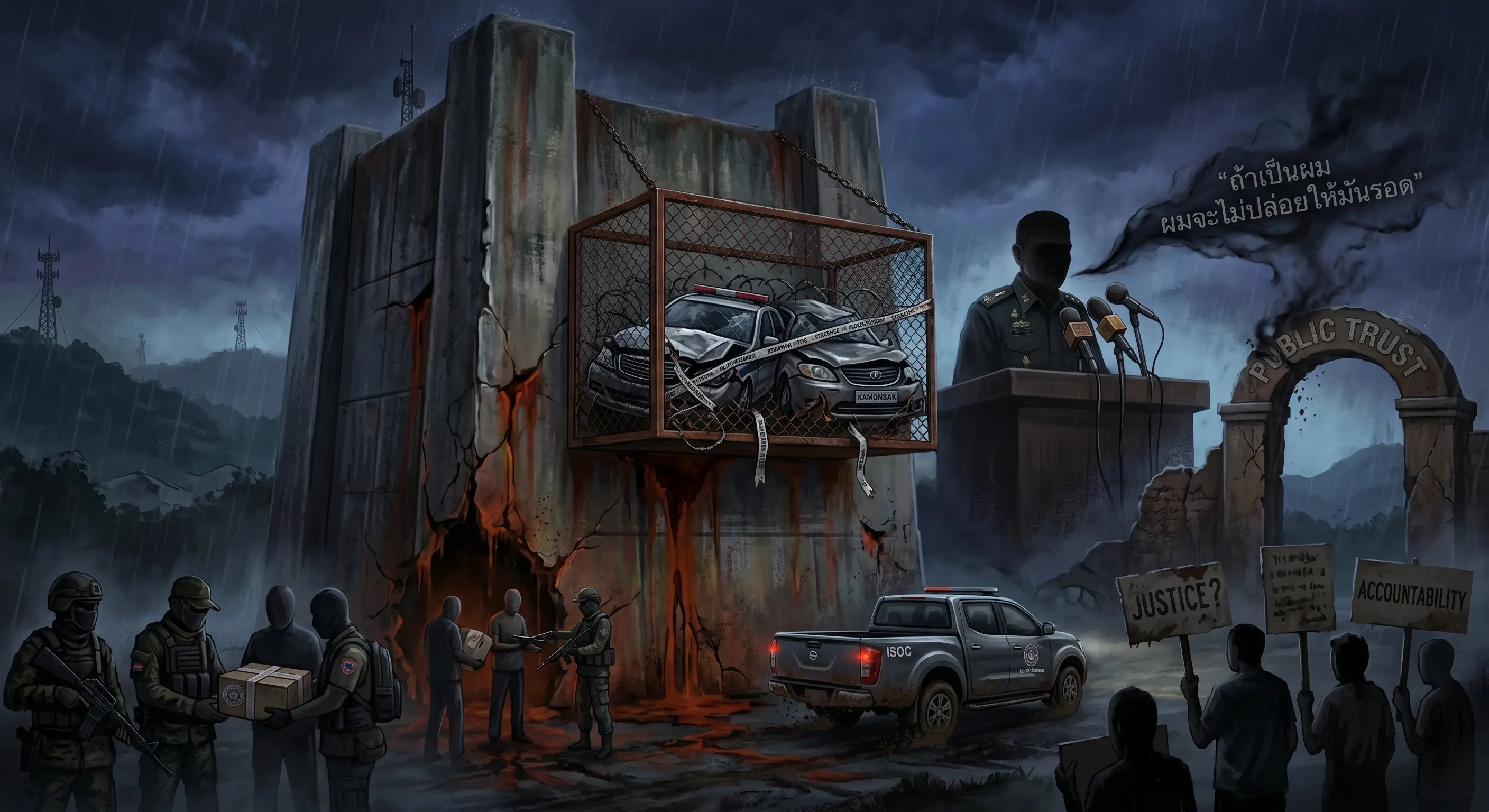
The March 2026 attack on MP Kamonsak Leewamoh, combined with an off‑microphone remark by Lt Gen Narathip Phoynork, has triggered public debate about accountability, oversight, and the role of security institutions in the Deep South.
This post documents the observable facts and situates them within previously identified structural mechanisms:
The purpose is to provide a forensic, non‑causal account of how a single incident reflects broader governance patterns.
According to publicly available reporting, the following elements are verifiable:
Additional reporting (April 2026) documents:
These facts form the empirical basis for the structural analysis below.
The incident contains two elements that align with previously documented patterns of administrative penetration:
A government vehicle associated with ISOC Region 4 was used by suspects.
This illustrates:
Among the suspects are individuals with:
This overlap does not imply institutional intent, but it demonstrates how security‑trained personnel can appear in incidents involving political actors.
These elements correspond to the structural mechanisms outlined in 0033 – Administrative Penetration and Parallel Governance.
During public communication, Lt Gen Narathip emphasized:
This framing aligns with patterns described in 0032 – Ideological Conditioning and Identity Production, where:
Subsequent clarification (April 2026) stated that these remarks referred to specific cases rather than entire systems.
The framing remains structurally relevant because it illustrates how ideological narratives are mobilized during crisis communication.
Public statements following the attack exhibit several recurring features:
The incident was initially framed as potentially personal or isolated.
Officials emphasized that the off‑mic remark was personal, not institutional.
Communication focused on:
Subsequent statements included:
These elements correspond to the narrative management patterns described in 0036 – Kamolsak Leewama Case Study.
The combination of:
has intensified public concern regarding:
Representatives of Islamic educational institutions expressed concern and requested the commander’s reassignment.
The government stated that these concerns would be reviewed within existing administrative procedures.
These dynamics are consistent with long‑standing trust challenges in the Deep South, where conflict has shaped perceptions of state protection and fairness.
The off‑microphone remark by Lt Gen Narathip — stating that he “would not have let him survive” — has direct implications for the integrity of law enforcement processes.
While the statement was framed as a personal comment, its institutional context is significant:
– the speaker holds command authority within ISOC Region 4
– the incident under investigation occurred within his operational jurisdiction
– the suspects include individuals with security‑related backgrounds
– a government‑issued vehicle was involved in the attack
These factors create a structural overlap between the investigating environment and the institutional hierarchy connected to the event.
Law enforcement agencies must operate independently of the command structure they may need to examine.
A senior officer’s public statement about how he would have acted in a violent incident introduces:
– potential pressure on subordinates
– perceived expectations within the hierarchy
– uncertainty about the boundaries of permissible conduct
This can influence witness cooperation, internal reporting, and the perceived safety of raising concerns.
Because ISOC Region 4 is part of the operational environment surrounding the case, the continued presence of the commander in his role may create:
– a conflict between institutional loyalty and investigative duties
– ambiguity about the chain of responsibility
– difficulty in ensuring that all relevant information is accessible to investigators
A temporary removal from command is a standard measure in systems where procedural integrity must be preserved.
In conflict‑affected regions, trust in state institutions is already fragile.
A remark implying acceptance of extrajudicial outcomes can:
– undermine confidence in the impartiality of the investigation
– reinforce perceptions of unequal accountability
– intensify public concern about the relationship between security actors and political violence
Public trust is a functional component of security governance; its erosion affects the legitimacy of both the investigation and the institutions involved.
A temporary suspension or reassignment is not a punitive measure but a procedural safeguard.
It ensures:
– a clear distinction between individual statements and institutional policy
– an environment in which investigators can operate without hierarchical influence
– the preservation of institutional credibility during an ongoing inquiry
The off‑mic remark also raises questions about the legal status of statements made by senior officers during official briefings.
In most governance systems, the distinction between personal opinion and institutional communication becomes blurred when:
This does not establish criminal liability; it highlights the sensitivity of public communication when senior officers comment on incidents involving political actors.
Following public concern, both the Prime Minister and Lt Gen Narathip issued public apologies.
The commander stated that his earlier remarks had caused unease due to miscommunication and clarified that references to educational institutions concerned specific cases rather than entire systems.
Representatives of pondok, tadika and private Islamic schools expressed concern and requested the commander’s reassignment.
The Prime Minister stated that these concerns would be reviewed within existing administrative procedures.
The commander announced an expansion of engagement activities between ISOC and educational institutions.
In conflict‑affected regions, such engagement is structurally sensitive because:
The announcement therefore forms part of the broader governance environment in which the incident and its aftermath are interpreted.
This post does not infer motives or assign responsibility.
Instead, it documents how the Narathiwat incident:
The incident does not introduce new mechanisms; it reinforces existing patterns.
Bangkok Post – 16 April 2026
https://www.bangkokpost.com/thailand/general/3237650/bloodcurdling-message-from-isoc-alarms-public
Bangkok Post – 17 April 2026
https://www.bangkokpost.com/thailand/general/3238815/pm-and-general-apologise-for-latters-troubling-talk
This post describes structural dynamics and observable facts.
It does not address individual motives, political positions, or institutional intent.