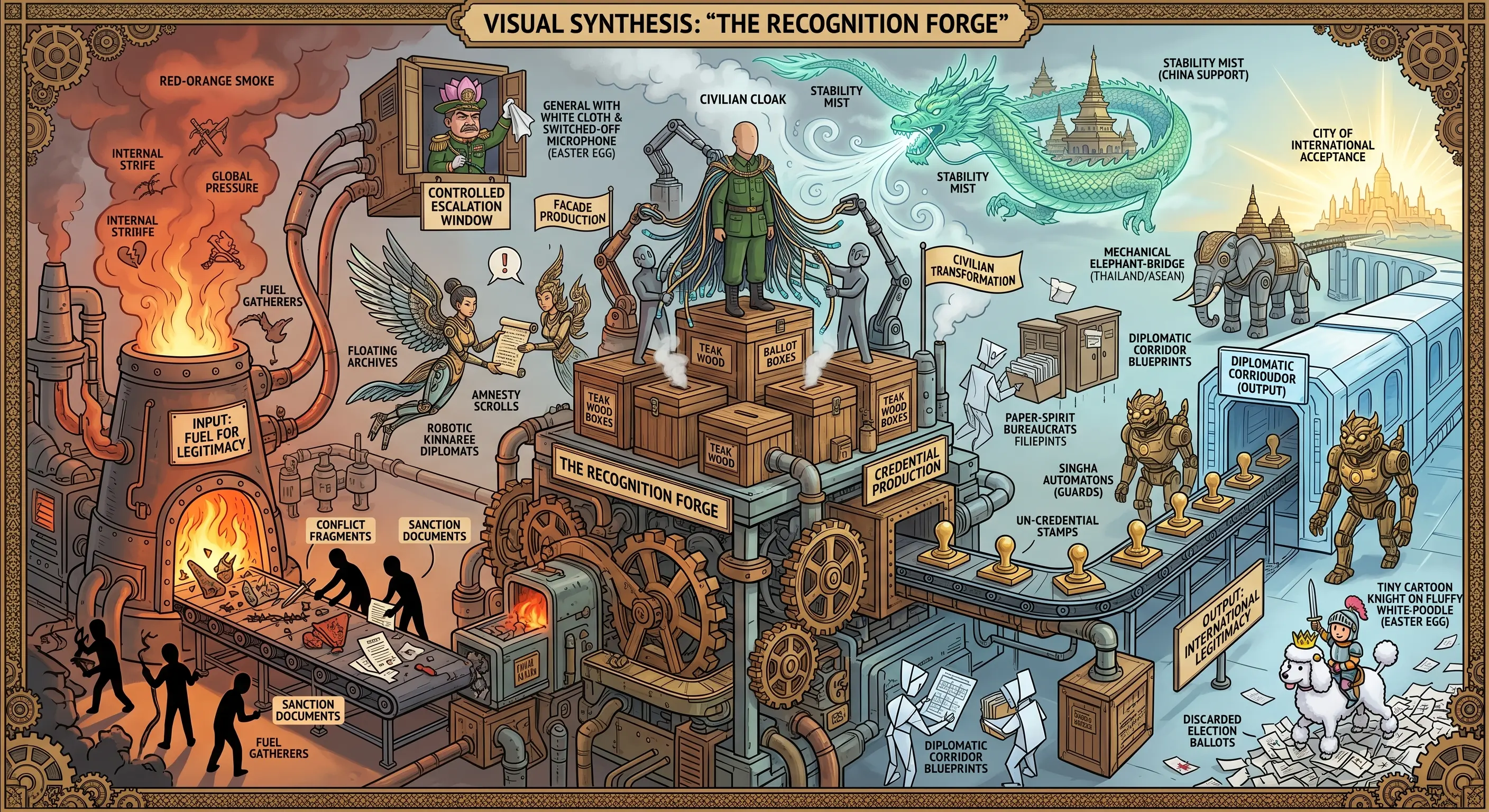
How the post‑coup government uses regional diplomacy to offset isolation and sanctions
1. Scope and Context
Following the 2021 coup and the subsequent five-year period of internal conflict, the military leadership in Myanmar has initiated a transition to a “quasi‑civilian” government. This shift, culminating in the inauguration of Min Aung Hlaing as President in April 2026, marks the beginning of a systematic diplomatic offensive.
This article documents:
the structural mechanisms of regional “Look East” diplomacy
the roles of China and Thailand as primary legitimacy anchors
the strategic reframing of internal crises to engage the Islamic world
the sequencing of regional recognition to influence UN credential politics
The purpose is to analyze the technical manufacture of international legitimacy through parallel diplomatic channels, situating these events within the broader framework of Dual Governance on an international scale.
2. Documented Facts
Reporting from the Bangkok Post (April 2026) establishes several verifiable elements:
The establishment of a new government following limited elections in late 2025/early 2026.
The formal inauguration of Min Aung Hlaing as President on April 10, 2026.
Immediate recognition and congratulatory visits from high-ranking officials from China, India, and Thailand.
The appointment of Tin Maung Swe (former Ambassador to Beijing) as Foreign Minister.
Diplomatic outreach to Bangladesh and Pakistan regarding the “Bengali issue” (Rohingya).
Coordinated ASEAN involvement, specifically the visit of Thai Foreign Minister Sihasak Phuangketkeow.
Strategic signals regarding the possible transfer of Aung San Suu Kyi to house arrest.
3. Structural Mechanisms of Legitimacy Engineering
3.1 Recognition Signalling and Sequencing
The legitimacy-seeking process follows a documented sequence designed to bypass Western consensus:
The Primary Anchor: Immediate personal congratulations from the Chinese Ambassador and the dispatch of a special envoy from Xi Jinping.
The Regional Interface: Formal recognition by Thailand as the first ASEAN member, providing a bilateral bridge to the multilateral bloc.
The Multilateral Layer: Reiteration of the ASEAN Five-Point Consensus as a formal “litmus test,” providing a framework for gradual re-integration.
3.2 Narrative Engineering: The “Elected” Façade
The transition to a “quasi-civilian” cabinet allows the regime to frame its authority through the language of constitutionalism. This creates a Front-End interface (elections, inaugurations, cabinet appointments) that serves as the basis for lobbying the UN Credentials Committee, even while the Back-End security logic (military control) remains unchanged.
This façade does not aim to convince Western observers but to provide procedural justification for recognition by regional partners and for claims before the UN Credentials Committee.
4. China as Back‑End Diplomatic Anchor
China functions as the structural stabilizer of the regime’s legitimacy:
Diplomatic Insulation: By congratulating the President first, Beijing sets a regional precedent that offsets Western sanctions.
The “Back-Seat Driver” Model: China defers to ASEAN as the official “leading force” (Front-End) while maintaining direct, high-level bilateral control (Back-End) over strategic interests and stability.
Personnel Alignment: The appointment of a pro-Beijing Foreign Minister ensures that Myanmar’s external interface is technically optimized for the “Look East” priority.
5. ASEAN as the Multilateral Filter
Thailand acts as the primary facilitator for Myanmar’s regional re-entry:
Bilateral Precedence: Prime Minister Anutin’s formal recognition frames the relationship as “long-standing ties,” prioritizing stability over democratic norms.
Signal Management: Using the health and status of Aung San Suu Kyi as a “signal” (amnesty/house arrest) allows the regime to perform concessions that meet the minimum requirements of regional observers without ceding power.
6. The Geopolitics of Reframing (Islamic‑World Outreach)
The outreach to Bangladesh and Pakistan illustrates a mechanism of Issue Externalization:
Corridor Geopolitics: The conceptualization of a Bangladesh-Myanmar-China corridor seeks to transform a humanitarian crisis (the Rohingya issue) into a developmental and strategic opportunity.
Third-Party Balancing: Engaging Pakistan and Bangladesh serves to balance Indian influence and secure legitimacy within the OIC (Organization of Islamic Cooperation) framework.
The outreach is not primarily ideological but instrumental: it reframes a domestic humanitarian crisis as a bilateral or trilateral diplomatic issue, thereby shifting the arena of negotiation.
7. Observable Patterns in Legitimacy Production
Across these documented elements, several patterns emerge:
Strategic Geographic Leveraging: Using Myanmar’s location as a “bridge” between South and Southeast Asia to compel regional cooperation.
Credential Sequencing: Attempting to convert regional acceptance (ASEAN/China) into formal UN representation.
Dual Communication: Maintaining rigid internal security operations while using “Thingyan amnesties” as soft-power signals for international audiences.
8. Analytical Synthesis
The legitimacy-seeking architecture of Myanmar in 2026 is a two-stage system:
The Back-End Anchor (China): Provides the necessary economic and political weight to resist Western pressure.
The Front-End Interface (ASEAN/Thailand): Provides the multilateral “filter” through which the regime is gradually re-normalized.
This architecture demonstrates that international legitimacy is not merely a legal status but a manufactured output of strategic sequencing, administrative rebranding, and regional signaling.
9. Notes
This article focuses exclusively on documented structural mechanisms and regional diplomatic patterns.
It does not infer individual motives or assign moral responsibility.