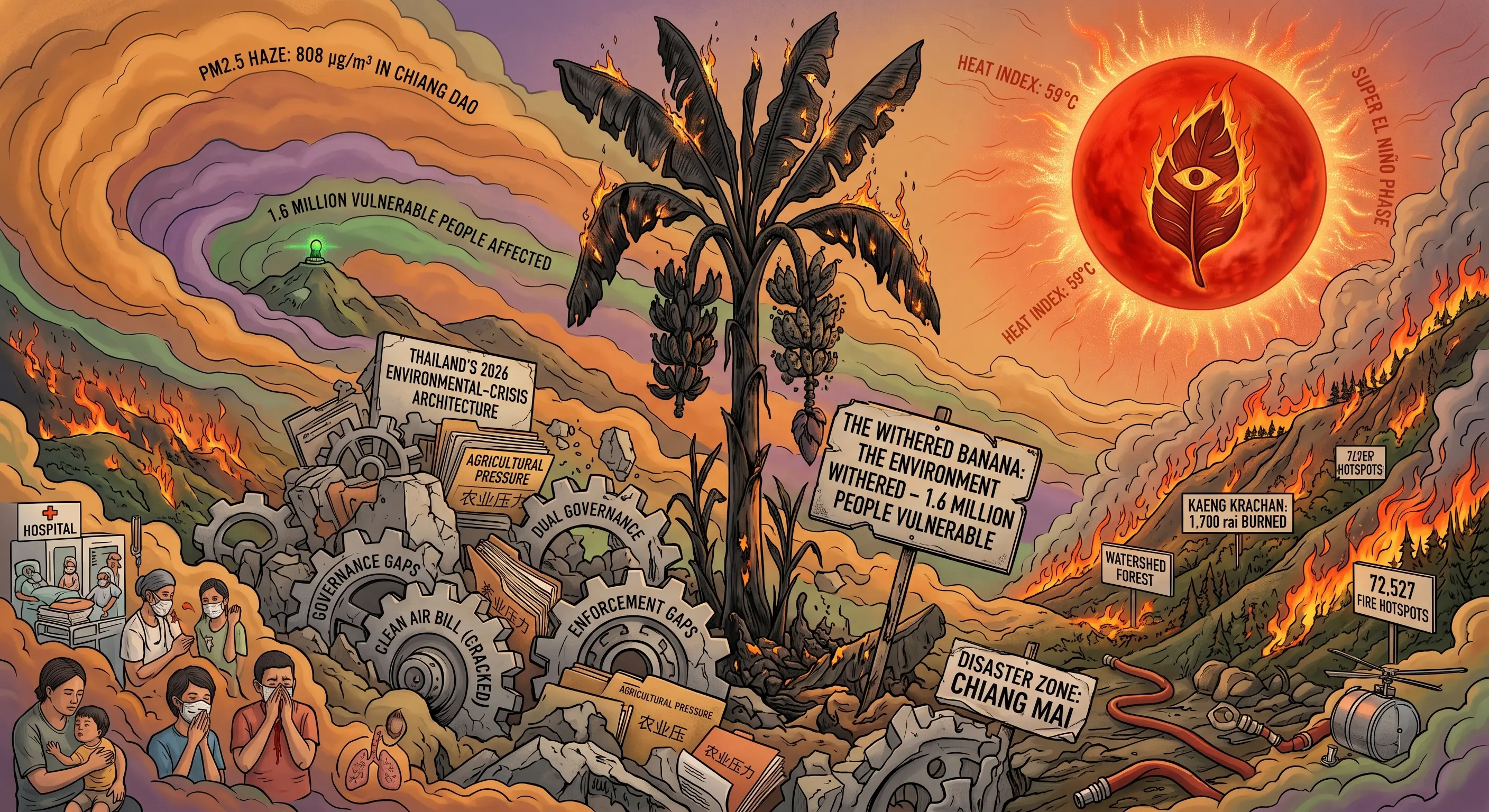
How heat, haze, wildfires and governance gaps converge into a multi‑layered systemic emergency
1. Scope and Context
Thailand is experiencing a rare convergence of environmental stressors in 2026.
Three parallel developments reinforce each other:
extreme heat driven by a potential Super El Niño
widespread wildfires across northern and western provinces
a severe PM2.5 haze crisis affecting millions
This article documents:
the climatic drivers behind extreme heat and prolonged drought
the structural mechanisms of wildfire ignition and spread
the health impacts of PM2.5 exposure in valley‑based urban regions
the governance dynamics surrounding the Clean Air Bill
the interaction between land‑use pressure, enforcement gaps and atmospheric conditions
The purpose is to analyze the architecture of a compound environmental crisis, situating these events within the broader framework of Dual Governance in environmental management.
2. Documented Facts
Reporting from the Bangkok Post (April 2026) establishes several verifiable elements:
PM2.5 levels in Chiang Dao district reached 808 µg/m³, over 20 times the safety threshold.
Chiang Mai ranked second globally for air pollution during peak haze days.
Over 1.6 million vulnerable people across 11 provinces were affected by hazardous air quality.
Northern Thailand recorded 72,527 wildfire hotspots since December — a 25% year‑on‑year increase.
A major fire in Kaeng Krachan National Park burned 1,700 rai of protected watershed forest.
Evidence of illegal land clearing was found in multiple plots within the park.
Experts warn that a Super El Niño may push heat indices to 59°C, posing severe health risks.
Hospitals in Chiang Mai reported more than double the usual number of pollution‑related cases.
Opposition parties renewed efforts to advance the Clean Air Bill, while some government MPs raised economic and legal concerns.
Chiang Mai declared multiple districts as disaster zones due to wildfires and haze.
3. Climatic Drivers of the 2026 Crisis
3.1 Super El Niño and Extreme Heat
Meteorological specialists warn that Thailand may enter a Super El Niño phase in late 2026, producing:
temperatures around 39°C
humidity above 60%
heat indices approaching 59°C
At these levels, core body temperature can reach 40°C within 10–15 minutes, creating a high risk of heat stroke.
3.2 Drought and Delayed Rainfall
Super El Niño conditions are expected to:
delay the onset of the rainy season
intensify drought
reduce soil moisture
increase wildfire susceptibility
These climatic factors form the background layer of the crisis architecture.
4. Wildfire Dynamics and Land‑Use Pressure
4.1 Hotspot Escalation
Northern Thailand recorded 2,165 active hotspots on April 14 alone.
The majority occurred in:
conservation forests
national reserves
Provinces with the highest counts:
Nan
Chiang Rai
Lampang
Chiang Mai
Tak
4.2 Kaeng Krachan Case Study
A major fire in Kaeng Krachan National Park revealed:
illegal tree felling
deliberate burning to prepare land for cultivation
two separate clearing sites
terrain requiring five hours of trekking for responders
The fire burned 1,700 rai of Class 1A watershed forest.
4.3 Terrain‑Driven Amplification
Steep slopes and inaccessible valleys:
slow response times
limit equipment transport
require helicopter water drops
allow fires to climb toward ridgelines
This creates a structural vulnerability in mountainous regions.
5. PM2.5 Exposure and Health Impacts
5.1 Extreme Concentrations
Chiang Dao district recorded 808 µg/m³, one of the highest values globally in 2026.
All 17 northern provinces exceeded safety limits.
5.2 Healthcare System Strain
Hospitals reported:
doubled outpatient numbers
increased cases of:
asthma
acute respiratory distress
nasal inflammation
nosebleeds
eye irritation
allergic skin reactions
5.3 Valley Exposure Mechanism
Cities located in valleys — such as Chiang Mai — experience:
temperature inversions
stagnant air
smoke accumulation from surrounding slopes
This creates smoke‑invasion events at temperatures near 40°C, combining heat stress with particulate exposure.
6. Governance Responses and Policy Dynamics
6.1 Clean Air Bill – Support
Opposition parties emphasize:
clean air as a basic right
the need for year‑round standards
protection for vulnerable groups
improved equipment and welfare for firefighters
structural reforms in agriculture and industry
6.2 Clean Air Bill – Concerns
Some government MPs warn that the bill may:
grant excessive powers to officials
overlap with existing laws
impose economic burdens
create new committees and agencies
lack clarity in enforcement mechanisms
6.3 Enforcement Gap
Multiple actors highlight that:
Thailand has extensive environmental legislation
the core issue is weak enforcement, especially in remote forest areas
illegal land clearing remains a persistent ignition source
This reflects a dual governance tension between formal regulation and practical implementation.
7. Observable Patterns in Crisis Formation
Across the documented elements, several structural patterns emerge:
Compound Risk: Heat, haze and wildfires reinforce each other.
Valley Entrapment: Topography amplifies PM2.5 exposure.
Land‑Use Pressure: Illegal clearing remains a primary ignition driver.
Operational Fatigue: Firefighters face prolonged deployments and injuries.
Governance Fragmentation: Multiple agencies with overlapping mandates.
Policy Polarization: Clean Air Bill debates reveal economic and legal tensions.
8. Analytical Synthesis
The 2026 environmental crisis in Thailand is not a sequence of isolated events but a multi‑layer architecture:
Climatic Layer: Super El Niño intensifies heat and drought.
Land‑Use Layer: Illegal clearing and agricultural burning ignite fires.
Topographic Layer: Valleys trap smoke and heat.
Health Layer: PM2.5 exposure overwhelms hospitals.
Governance Layer: Enforcement gaps and policy fragmentation limit response capacity.
This architecture demonstrates that environmental crises emerge from the interaction of natural conditions and human systems, not from climate alone.
9. Notes
This article focuses exclusively on documented environmental, climatic and governance mechanisms.
It does not infer individual motives or assign moral responsibility.